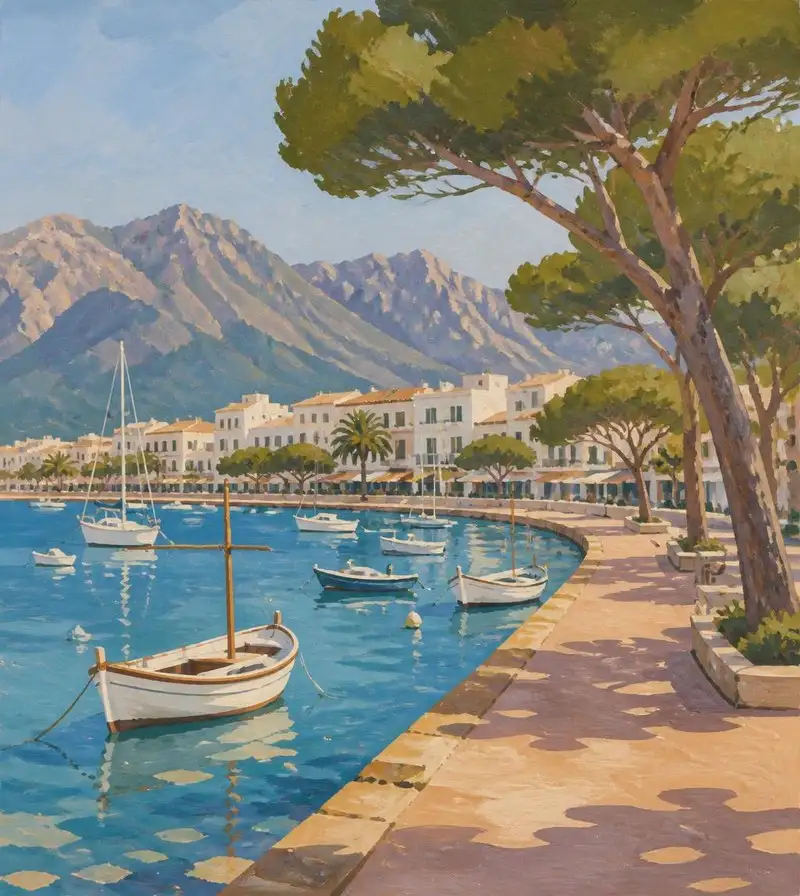
Port de Pollença
460.000 - 1.070.000 €Indicative guide pricesIt is priced above the municipal asking figure, and it is rising faster than the municipality over the year.
Port
Port de Pollença asks more per square metre than the district that shares the municipality's name, roughly a fifth more in the July 2026 report, and rising almost twice as fast. A third district, Cala Sant Vicenç, carries no price at all, so a buyer there has no district-level benchmark. And the name itself is a trap: a district row and a municipality row both go by Pollença, covering different areas at different prices.
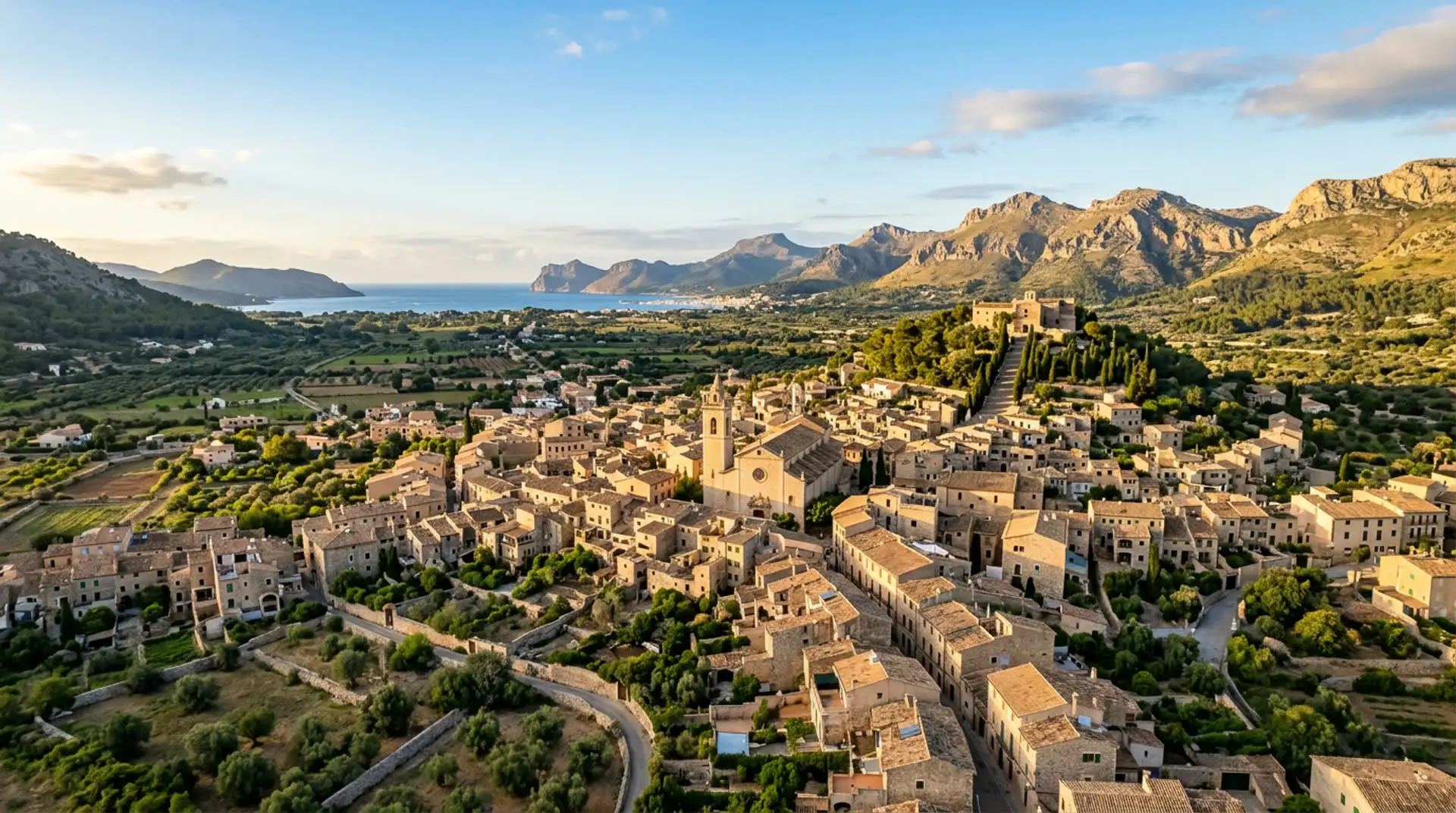
Just under eighteen thousand people live across the municipality, on the Censo Anual count at 1 January 2025. Just over a quarter of them hold a foreign nationality and just over three in ten were born outside Spain, both figures derived by subtraction because INE publishes neither total. The space between those two measures is naturalisation. British nationals are the largest single foreign nationality in the nationality count, ahead of Romanian, Italian, Colombian and German. That is who lives here, which is a different question from who buys.
Two things this guide cannot hand you. There is no climate table, because AEMET's principal-stations normals publication lists no station here; it does run an observing station at Port de Pollença, but current observations are not normals and must not be read as them. And there is no train, because Pollença appears on none of the published stop lists. Health cover is more local: a health centre in the municipality itself.
The verdict
The upside is real. So is the downside. Both matter more than any brochure will admit.
The two priced districts are separated out
The July 2026 report gives an asking price per square metre for the district named Pollença and for Port de Pollença on their own rows, so the gap between them is visible rather than blended away into one municipal figure.
British nationals lead the resident nationality table
In the Censo Anual for 1 January 2025, British nationals are the largest single foreign nationality recorded here, 926 of them, ahead of Romanian, Italian, Colombian, German and Moroccan nationals. That is resident stock, not buyers.
A health centre inside the municipality
IB-Salut lists CS de Pollença as the municipality's own health centre and places the municipality in the Tramuntana health sector, whose published reference hospital is Hospital Comarcal de Inca. Retrieved 1 September 2026.
Three in ten residents were born outside Spain
Derived by subtraction from the Censo Anual totals for 1 January 2025, 5,360 of the 17,801 residents were born abroad. Birthplace is the steadier measure of the two, because naturalisation does not move it the way nationality does.
The two official population counts nearly agree
The padron gives 17,807 for 1 January 2025 and the Censo Anual gives 17,801, six people apart. On the other three Mallorcan municipalities we cover, the Censo Anual comes out higher; here it is lower.
No published climate normals for the municipality
AEMET's normals publication for 1981 to 2010 lists four principal stations under Illes Balears and none of them is here, so we print no climate table. The station at Port de Pollença publishes current observations, which are a different thing.
No train service and no station here
The island's transport authority publishes lines for Mallorca, and Pollença appears on none of the T1, T2 or T3 stop lists. Sa Pobla, the T2 terminus, is a separate municipality. There is no service to point you at.
Cala Sant Vicenç carries no published price
It appears in the July 2026 district list with no figure beside it. The stated rule is that an area without a minimum sample of adverts is rolled up to the layer above, so a buyer there has no benchmark to check against.
Two different rows share the name Pollença
The same July 2026 report carries a municipality-tier row and a district-tier row both labelled Pollença. They cover different areas and carry different asking prices, and the label alone will not tell you which one a quoted figure came from.
The reference hospital is in another municipality
IB-Salut names Hospital Comarcal de Inca as the Tramuntana sector's reference hospital, and Inca is a separate municipality. What is published inside Pollença is a health centre. We publish no distances or travel times anywhere.
Editor's note
Pollença suits a buyer who has a view about the town-versus-port question and wants the two priced apart rather than averaged. If the split is the appealing part, both Palma and Alcúdia are broken into districts on our list, Palma into far more of them, with thirteen of its sixteen carrying a July 2026 price against three of three in Alcúdia. If a climate table matters to you, AEMET publishes normals for two stations it names for Palma, and Palma is also the municipality on our list that the published train and metro lines serve, with the caveat that it is split across at least two health sectors and no single reference hospital can be named for it. If you would rather be somewhere with a smaller foreign-national share, Menorca is the lowest of the four islands we cover, a little over a seventh of residents against just over a quarter here. And nothing in this batch covers rents, running costs or housing stock, so there are no figures behind the second-home and holiday-let questions on any of our pages.
Updated 1 Sept 2026
INE Annual Population Census, nationality basis, 1 January 2025
Where to live and what to expect at each price point.
It is priced above the municipal asking figure, and it is rising faster than the municipality over the year.

Asking prices are below the municipal figure. Annual price movement was similar compared with the municipality.
Honest answers to the questions buyers actually ask.
Transfer tax rates as of August 2026. Rates are set per autonomous community and do change. Confirm the current figures with a Spanish lawyer or tax adviser before you budget.
The pros and the cons of every town, with sourced data on prices, climate and costs.
Your property search, saved cities, mortgage calculator and a step-by-step buying guide, from your first search to getting the keys.
Local agents who speak your language, and owners selling their own home, contact you about homes that fit your search.
Agents and owners ask to connect first. Your contact details are only shared with the people you accept.
Our comprehensive guide covers everything foreign buyers need to know - from NIE numbers and residency permits to mortgages and legal requirements.
Use our free mortgage calculator to estimate monthly payments, compare loan scenarios and understand the true cost of buying in Spain.